
Tagi produktu
- Nowość
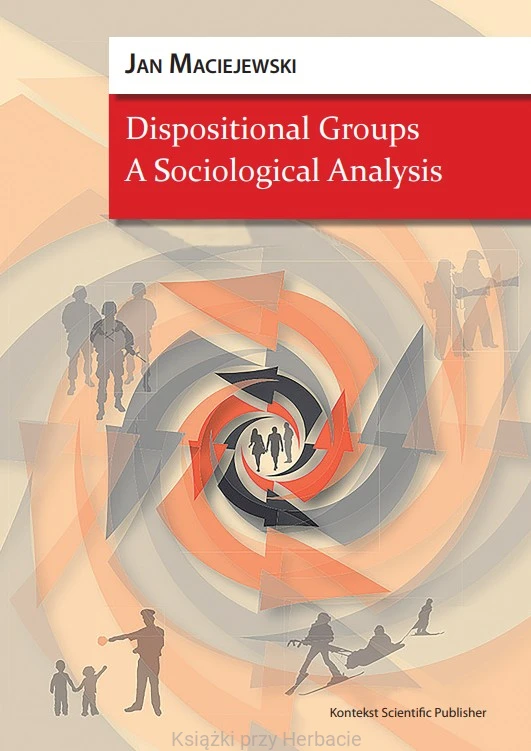
Dispositional Groups. A Sociological Analysis - Jan Maciejewski
Wystaw opinię o produkcie

Open access book
Punktowana monografia naukowa – pobierz za darmo!
Nie dodawaj do koszyka e-booka, jeśli chcesz pobrać go szybko.
Poniżej znajduje się zakładka Pliki do pobrania.
Otwórz ją i jednym kliknięciem pobierz e-book za darmo!
Kurier InPost
Koszty dostawy wybranego produktu
-
home Kurier InPost Darmowa
Kurier InPost
-
Przesyłka kurierska Darmowa
Kurier DHL lub DPD
-
Shoper Przesyłki Dostawa do punktu 9,90 zł
-
Poczta Polska (priorytet) 0,01 zł
przesyłka priorytetowa
Cena dostawy dotyczy tego produktu (w wybranym wariancie - jeśli dotyczy). Może się ona zmienić po dodaniu innych produktów do koszyka.
Kod produktu: EC93-945D0
Opis
Jan Maciejewski, Dispositional Groups. A Sociological Analysis, Third Edition, Kontekst Scientific Publisher, Poznań 2026.
ISBN 978-83-68332-30-8
DOI: 10.5281/zenodo.20049789
Abstract Drawing on over thirty years of my own research, I have formulated a working definition of the sociology of response teams as a sociological sub-discipline. It focuses on the analysis of organised structures operating within security systems – military, paramilitary and civilian – which can respond rapidly in emergency situations to protect society and the state’s key resources. The sociology of rapid-response groups lies at the intersection of academic disciplines such as the sociology of the military, the sociology of organisations, the sociology of work, security studies and social psychology. Research in this discipline focuses, among other things, on the conditions for the formation and functioning of rapid-response groups, the principles of member selection and recruitment, training methods, and the role of these structures in a changing social environment.
Keywords Threat, security, rapid reaction forces, state military, paramilitary and civil security systems, selection, recruitment and training.
Reviewers Prof. Danuta Walczak-Duraj, University of Łódź Prof. Aleksander Manterys, Warsaw University Lt. Iwona Szkudlarek, Phd (Eng.), Karkonosze University of Applied Sciences
SummaryThe present monograph is an attempt to carry out a sociological analysis of dispositional groups. The structure of the book is determined by the author’s desire to present the subject in a clear manner. The results of the analyses reflect the current social-sociological and political situation of society, i.e. they will need updating in the future. The book consists of four chapters. In chapter one, the author defines the term “social group” as it is understood popularly and scientifically. In addition, he carries out a systematic analysis of the typology of social groups and establishes the systemic determinants of their functioning. Social groups are the basic elements of various social systems. They can be formed spontaneously or deliberately. They have – given their nature – a specific structure consisting of specific elements. Their level of organisation and, consequently, formalisation varies; in addition, they have their own characteristic means of integration and their own values, which their members respect. There is a large body of literature devoted to the characteristics of social groups and based on numerous sociological studies of these groups. It turns out, however, that the development of sociology and analyses of various structures undertaken within it have made it possible to distinguish among the various social groups, also those that perform special functions in the military, paramilitary and some civilian social systems. These groups, called dispositional groups, are examined in chapter two of the present monograph as a special type of social groups within the state security system. The specific nature of these groups is presented through a reference to the sociology of labour. Owing to their variety, the author distinguishes among them military, paramilitary, civilian and voluntary groups.What are dispositional groups? The answer to this question is by no means easy and is associated with, among others, the scope of dispositionality of the analysed groups. Since the term “dispositional” is by no means unequivocal, a large part of the chapter is devoted to making this notion more specific. It is worth noting that e.g. the armed forces of a state constitute a complex social structure, i.e. a military system, which should be constantly prepared to perform defensive tasks, safeguarding that state’s sovereignty and integrity. This constant preparedness of the mili-tary system to perform tasks set for it by state authorities is its dispositionality in a broad sense of the term. However, we know that each system consists of many subsystems, i.e. various components of its morphology. The armed forces are composed of many mili-tary units, e.g. divisions, brigades, platoons and similar structures as well as various entities performing particularly important functions within this system, e.g. military police, rapid reaction forces, etc. Structures which are required not only to be constantly ready to act, but also to be ready to act immediately in any conditions, when a relevant order is given are dispositional in the strict (narrow) sense of the word. Structures which meet this requirement are called dispositional groups. Of course, just like in the military system, such dispositional groups – in the narrow sense of the term – can also be found in paramilitary or civilian systems. For instance, within the police force these are anti-terrorist squads, while in civilian systems – various emergency or rescue services able to undertake various rescue operations in order to counteract the existing threats to human life or health, to the natural environment or to the infrastructure. In his studies of dispositional groups the author has established that they differ not only in terms of the systems in which they were formed, but also in terms of the specific nature of these systems. In the military system, for example, we can notice differences between units permanently charged with ensuring security of the airspace of a given country, and intelligence or ounter-intelligence units, or rapid reaction forces. This also applies to the paramilitary system, e.g. intervention units within the police force differ in their nature from special task units. Similarly, various emergency services in the civilian systems, e.g. ambulance service and volunteer mountain rescue service, differ substantially in terms of their dispositionality. In addition, chapter two is an attempt to present the fully-formed role models of members of the various dispositional groups, i.e. to define the elements that constitute those models. What all dispositional groups have in common – in connection with the role models of their members – is the fact that people employed in them are prepared to immediately take various types of action. These people must be prepared to act – regardless of the existing conditions – in order to counteract the effects of various incidents, e.g. natural disasters, accidents, including road accidents, and similar situations which involve a threat to people, natural environment or resources of a given country. Those taking action are well aware of the fact that state security, safety of its citizens, property and other values depend on how well they perform their tasks. For this reason members of dispositional groups enjoy considerable trust in society and prestige in every country. In chapter three the author discusses psychosocial traits of members of the various dispositional groups, the socio-demographic determinants of recruitment to these groups, as well as issues related to professional preparation of their members. In the last, fourth chapter the author analyses the results of long-term theoretical and empirical studies, which have made it possible to collect the material concerning the groups in question. The results may constitute the basis for further scholarly analyses of issues related to the sociology of dispositional groups. The sociology of dispositional groups is a new proposal of a theory, which focuses on specific social groups, existing within specific social systems. These are groups serving particularly important functions regardless of the time, place and existing conditions, if a need arises for them to act. The sociology of dispositional groups uses the achievements of, among others, the sociology of the military, labour, large and small social groups, as well as the achievements of social psychology. It studies, e.g. the specific nature of the various dispositional groups; the ways they are formed and organised; the recruitment to the groups and processes of their professionalisation; the shaping of social functions and positions in these groups as well as personal careers of their members; the determinants of role models of members of these groups as well as their ethos and prestige they enjoy in society. Thus, studies of dispositional groups may provide an impulse for the development of sociology, for this discipline – just like any discipline of science – develops not only outwards, expanding its research field, but also inwards, enriching its scope by including in it newly noticed social facts.
Translated by Anna Kijak
Opinie
Jeśli dodałeś/-aś recenzję, a nie pojawiłą się na liście, być może oczekuje na moderację.
Wystaw opinię o produkcie
Pliki do pobrania
 Dispositional-Groups-digital.pdf
14.82 MB
Pobierz plik!
Bezpieczeństwo produktu
Producent
Wydawnictwo KONTEKST Tomasz Magowski
ul. Plauta
60-461 Poznań, Polska
61 8518-511 kontakt@wkn.com.pl Zgłoś problem z bezpieczeństwem produktu


